Kawaii – The History, the Characters & the Collectibles
It began as banned handwriting in Japanese schools. Today it is one of the most recognisable aesthetics in the world.
Techbox, Thessaloniki
What kawaii actually is
The word kawaii (かわいい) translates as "cute". But the English word does not carry the same meaning.
In English, "cute" can be said condescendingly or ironically. Kawaii carries no such ambivalence: it applies only to things that are lovable and loved.
As a visual language it has specific traits:
- Round faces and small bodies
- Large eyes, a small or absent nose
- Minimal expression – close to neutral
- Bright or pastel colours, with thick black outlines
Nothing sharp, nothing threatening. And – as we will see – the minimal expression is not accidental.
The banned handwriting – where it all began
Modern kawaii culture did not begin with a company or a designer. It began with teenage schoolgirls, in 1970s Japan.
And the trigger was practical: mechanical pencils allowed far thinner strokes than before, and therefore more individual handwriting.
Girls began writing in rounded, bubbly letters, mixing hearts, stars and little faces into the text. And – crucially – horizontally rather than vertically, breaking with the tradition of Japanese writing.
The style acquired several names: marui-ji ("round writing"), koneko-ji ("kitten writing"), burikko-ji ("fake-child writing").
Schools reacted. In many, the handwriting was banned – it was hard to read and considered improper.
It spread anyway.
Research later showed the girls invented it themselves, spontaneously – they did not copy it from comics, as many assumed. The evidence: the handwriting predates the technical means that would have allowed rounded lettering in comics.
In a post-war society that placed heavy weight on conformity, it was a quiet form of resistance. Within a few years, the same magazines and advertisers who had ignored it adopted it.
From sandals to Hello Kitty
Sanrio – the company that gave kawaii its faces – did not start out as a character company.
It was founded in 1960 by Shintaro Tsuji as a silk company, selling among other things rubber sandals.
Tsuji noticed something simple: sandals with cute designs on them sold better than plain ones. He built everything else on that single observation.
The company was renamed Sanrio in 1973. The following year, in 1974, Hello Kitty appeared.
And she is not a cat. Sanrio officially describes her as a little girl. Her name is Kitty White, she lives in London, has a twin sister called Mimmy – and she has a cat as a pet.
The comparison the company itself makes: much as Mickey Mouse is a mouse who wears shorts and gloves.
Why she has no mouth – and why it matters
It is the question everyone asks. And the answer explains why the whole aesthetic works.
Yuko Yamaguchi, who designed Hello Kitty for decades, explained it to Time magazine: the mouth is missing deliberately.
With an expressionless face, each person projects their own feelings onto her. She looks happy when you are happy. She looks sad when you are sad.
She is tied to no single emotion – and that is why she suits every mood.
The same applies to other Sanrio characters such as Pochacco and Mimmy. Others – Kuromi, Cinnamoroll – do have mouths, and consequently have far more defined personalities.
Who ranks first today – it may surprise you
Sanrio runs an official annual popularity poll of its characters. The results of recent years overturn what most people expect.
In the 2025 ranking she came fifth. The top three places went to dogs:
Golden dog in a beret
White, with long ears
White, no mouth
Black and pink, skull bow
A Sanrio executive acknowledged it openly: reliance on Hello Kitty has been steadily decreasing over the past two decades.
In the 2026 ranking Kuromi placed fourth worldwide – but third in Germany, France and Australia, while only fifth in the United States.
Kuromi is stronger in Europe than she is in America.
The explanation is straightforward: Kuromi is the "dark" kawaii – black and pink, with a skull on her hood, mischievous rather than sweet. She appeals to teenagers and adults who find the other characters too sweet.
What to choose
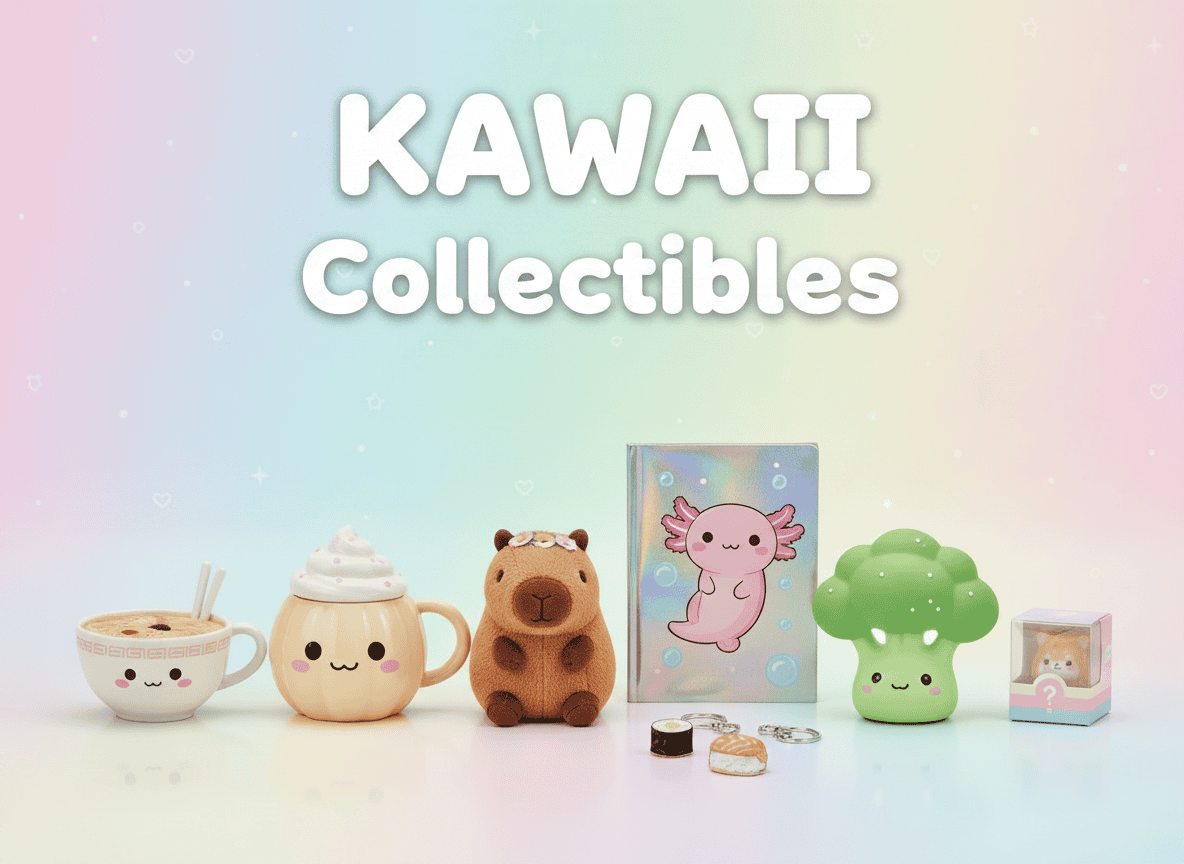
Kawaii's great advantage: it is an aesthetic, not a franchise. There is no film to have seen and no story to know. If someone likes soft colours, almost anything here works.
- Mugs & bottles: the most-given gift – used every day.
- Plush: from small desk companions to larger ones for hugging.
- Keyrings: they go on a bag and are seen daily.
- Lights & 3D lamps: these are the ones that impress when the box opens.
- Stationery: where the aesthetic began – and still one of its strongest categories.
- Small gifts: magnets, air fresheners, small shelf pieces.
In practice: for a child, or anyone who likes things sweet, choose Cinnamoroll, Pompompurin or My Melody. For a teenager or adult with darker taste, Kuromi.
And one thing that makes kawaii unusually easy: the palette is consistent. Items bought months apart still match – the collection builds itself.
See also Hello Kitty and Squishmallows.
Frequently asked questions
- What does kawaii mean?
- It is the Japanese word for "cute", but without the ambivalence the English word can carry – it applies only to things that are lovable. As a visual language: round faces, large eyes, a small or absent nose, minimal expression.
- How did kawaii culture begin?
- With teenage schoolgirls in 1970s Japan, who began writing in rounded letters with little drawings – the style known as marui-ji. Mechanical pencils made it technically possible. Many schools banned it; it spread anyway.
- Why does Hello Kitty have no mouth?
- Deliberately. Her designer explained that with an expressionless face each person projects their own feelings onto her: she looks happy when you are happy, and sad when you are sad.
- Is Hello Kitty a cat?
- Not according to Sanrio. The company officially describes her as a little girl – Kitty White, who lives in London and has a cat as a pet.
- Which character is most popular today?
- Not Hello Kitty. In Sanrio's official 2025 ranking she came fifth: first was Pompompurin, second Cinnamoroll, third Pochacco and fourth Kuromi.
- Is it only for children?
- No. Kawaii crosses ages. Kuromi in particular – black and pink, mischievous rather than sweet – is aimed at teenagers and adults, and is more popular in Europe than in America.